Safety Valve
Pressure Vacuum Relief Valve

About The Product

Advanced Vapor Control & Tank Protection System Engineered to safeguard storage tanks from excessive pressure and vacuum conditions, the Valvyn Breather Valve ensures operational safety, minimizes product loss, and reduces environmental emissions during filling, emptying, and thermal expansion.

WORKING PRINCIPLE:The valve remains closed under normal tank conditions:

Pressure Relief Mode: Opens when internal pressure exceeds the set limit, safely releasing vapors

Vacuum Relief Mode: Opens when vacuum exceeds permissible levels, allowing atmospheric air inside

WHY VALVYN:

  • Optimized for low emission losses
  • Reliable long-term sealing performance
  • Designed as per global standards (API 2000)
  • Custom-built solutions for critical applications
  • Full Lift achieves only at 10% overpressure.
Safety Relief Valve
Model NUMBER:VYN-BRV-3300 Series

Features

  • Precision-set pressure & vacuum relief
  • Bubble-tight soft seated sealing
  • Rugged, corrosion-resistant construction
  • Compact design with easy maintenance access
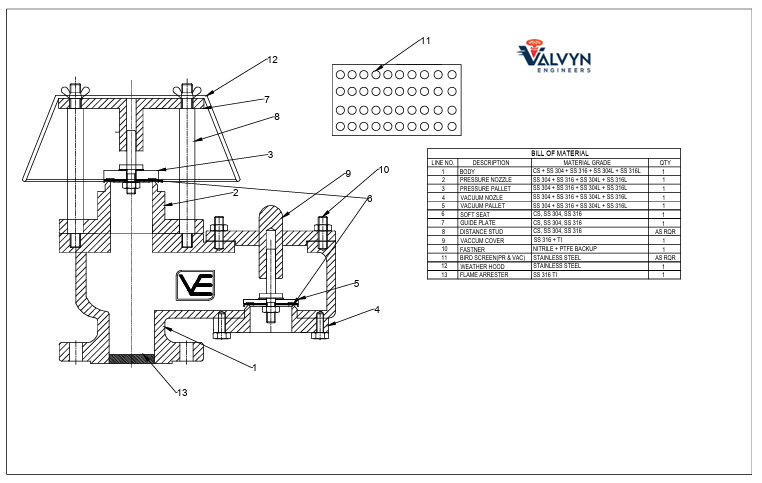
  • Optional flame arrestor integration
  • Weather protection hood for outdoor use

Technical Specifications

  • Body:CS / SS304 / SS316 /Duplex / Aluminium / PTFE
  • Pallet:SS304 / SS316 / Hast Alloy C / PTFE
  • Seat:PTFE / FKM / Viton / Neoprene
  • Gasket: PTFE / CAF / Graphite
  • Fasteners: CS / SS304 / SS316
  • Size Range: 1” to 12” (DN25–DN300)
  • Pressure Setting:+5 to +500 mmWC Weight Loaded & 500 mmWC and above spring loaded
  • Vacuum Setting: -5 to -500 mmWC
  • Operating Temp: -20°C to +200°C (typical)
  • Leakage Class: As per API 527
  • Flow Capacity:As per API 2000 calculation
Safety Relief Valve
Model NUMBER:VYN-BRV-3300P Series

DESIGN BASIS

  • Designed to protect low-pressure storage tanks against overpressure and vacuum conditions
  • Suitable for API 2000 venting requirements (normal & emergency venting)
  • Ensures minimum product loss and controlled vapor emission
  • Designed for set pressures in mmWC range (very low pressure accuracy)

MECHANICAL DESIGN

    Valve Type

  • Weight-loaded / Spring-loaded (based on application)
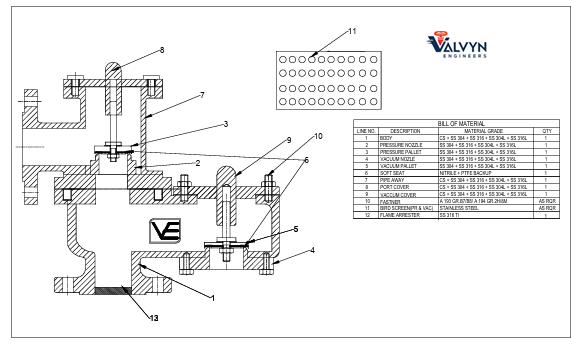
  • Pressure & Vacuum dual pallet design
  • Construction

  • Modular body with removable internals
  • Replaceable seat and sealing elements
  • Guided pallet assembly for stable operation

DESIGN STANDARDS & CODES

  • API 2000 / ISO 28300 – Venting of Atmospheric & Low Pressure Storage Tanks
  • API 527 – Seat Tightness of Pressure Relief Valves
  • ASME Section VIII (Guidelines) – Pressure vessel considerations
  • ISO / DIN / ANSI – Flange compatibility

FLOW & PERFORMANCE DESIGN

  • Designed for stable lift characteristics with minimal chatter
  • Full lift achieved at 10% overpressure
  • Low pressure drops across valve during venting
  • Smooth reseating to prevent vapor loss

TESTING & QUALITY

  • Seat leakage test (API 527)
  • Set pressure calibration test
  • Hydro / Pneumatic test (if applicable)
  • Material traceability & inspection reports

CONNECTION & INSTALLATION

  • Flanged: ANSI B16.5 / DIN / IS
  • Threaded: BSP / NPT (small sizes)
  • Vertical mounting on tank roof
  • Easy access for inspection & maintenance

OPTIONAL FEATURES

  • Integrated Flame Arrestor (Inline / End-of-Line)
  • PTFE-Coating internals for corrosive service
  • Vacuum breaker integration (Blanketing regulator)

DESIGN ADVANTAGES

  • Accurate low-pressure control (mmWC range)
  • Long service life with minimal maintenance
  • Compact and lightweight design
  • Custom engineered for specific tank conditions

ENVIRONMENTAL & SAFETY DESIGN

  • Weather hood to prevent ingress of rain/dust
  • Flame arrestor provision (optional integration)
  • Designed to reduce fugitive emissions
  • Anti-icing / anti-sticking provisions (optional)

SEALING & LEAK TIGHTNESS

  • Soft seated design for bubble-tight sealing
  • Precision machined seat for low leakage rates
  • Suitable for volatile and hazardous fluids

VALVYN ENGINEERING NOTE

Breather valves shall be sized based on inbreathing and outbreathing flow rates as per API 2000, considering:

Filling/emptying rate
Thermal effects
Blanketing system interaction
Chemical
Pharmaceuticals